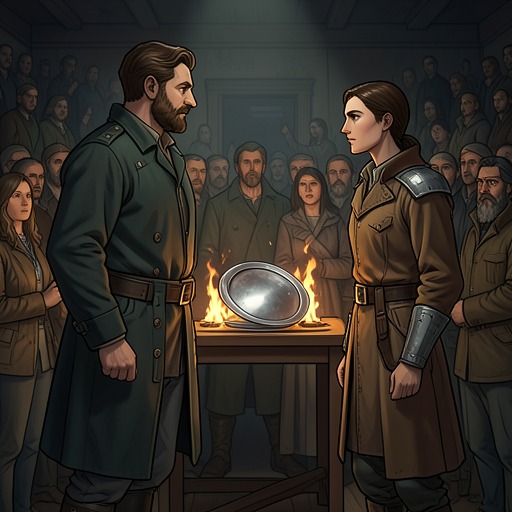
Mind is the man
Metamorphoses (Ovid Edition)“Mind is the man” crystallizes the passage’s central claim that intellect, not physical force alone, constitutes a person’s essential worth. The expression appears in a speech defending prudent judgment against brute strength: the body may perform useful labor, but the mind gives that labor direction, timing, and purpose.
Definition and Context
The phrase is presented as the culmination of an argument about competing kinds of power. The speaker acknowledges that “boist’rous hands” can be useful when guided by a directing head, but refuses to let muscular capacity stand for complete merit. Strength has a function; it is not the whole measure of a human being. The expression therefore operates both as a maxim and as a rebuttal, converting a quarrel over physical superiority into a larger claim about what makes an individual valuable.
The surrounding speech contrasts the hand with the head, the body with the mind, and force with judgment. The speaker insists that bodily power becomes truly effective only when applied under intelligent direction. “Brawn without brain is thine” reduces ungoverned strength to an incomplete instrument, while prudent care is credited with foreseeing, providing, and administering the war. The phrase’s force comes from this reversal: what first appears to be superiority in combat is exposed as dependence upon an unseen intellectual command.
Judgment as the Direction of Force
The expression does not deny the usefulness of strength. It assigns strength a limited province: “Thy province is to fight.” The decisive authority, however, belongs to the king’s adviser, who determines when fighting should occur. This distinction places judgment above mere action. A warrior may possess the capacity to strike, but someone must decide whether the moment is right, what resources are required, and how the wider campaign should be managed.
The speaker accordingly claims responsibility for the war’s organization rather than its visible violence. Prudence “foresees, provides, administers”; these three functions extend intelligence across time, resources, and command. The mind anticipates danger, supplies what action needs, and coordinates the consequences of action. In this framework, physical force is comparable to an instrument whose value depends upon the intelligence controlling it. The maxim “Mind is the man” names the governing principle behind that hierarchy.
A Claim to Merit and Recognition
The phrase also functions as a demand for proper reward. The speaker does not merely offer an abstract theory of human nature; he asks the Greek chiefs to recognize the services performed by their “watchman of the war.” His merit lies in vigilance, calculation, and counsel, even though those contributions may be less conspicuous than feats of combat. The appeal is directed toward an audience that has witnessed military rivalry and must decide whose achievements deserve honor.
The argument becomes sharper because the speaker concedes the rival’s superior strength while denying that this concession settles the dispute. “What gain’st thou, brutal man, if I confess / Thy strength superior, when thy wit is less?” Physical victory, on its own terms, cannot erase intellectual inferiority. The speaker claims his “whole desert” from “the mind’s vigour, and th’ immortal part,” presenting thought as both an active power and the element most closely associated with enduring human identity.
Rhetorical Structure and Significance
As rhetoric, “Mind is the man” is brief, memorable, and aphoristic. Its compressed form makes the conclusion sound like a general law rather than a private defense. The surrounding antitheses—hands and head, brawn and brain, body and mind, fighting and deciding—give the maxim a clear argumentative structure. The speech relies chiefly on logos, since it explains how military success depends on planning and command, but it also invokes ethos by presenting the speaker as prudent, vigilant, and responsible for collective safety.
The expression’s significance lies in its refusal to equate visible power with complete personhood. The body is acknowledged as “of profit,” yet the mind is treated as the defining and potentially immortal part. In the immediate dispute, this elevates counsel over violence and seeks recognition for intellectual labor. More broadly, the maxim establishes a hierarchy in which force is valuable only when disciplined by judgment: strength can execute an action, but intelligence determines its meaning, necessity, and time.